Herman von Poellnitz - 1891 - 1918.
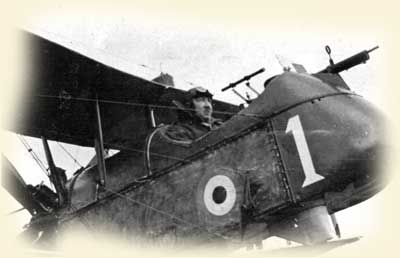 |
The story of Wynne's cousin, Herman is a sad one, because he died in a stupid accident in May 1918, just when he was reaching his full potential in the new Air Force. He was born in 1891 to Arthur and Lena von Poellnitz, Wynne's uncle and aunt. Arthur was Blanche Llewhellin's brother, often called Thurie in the diaries.
Herman was always destined for the military, and he joined up in 1910 as a gentleman cadet. He was serving on Gibraltar when war broke out, but was back in the trenches in time to get trench foot and be invalided out in November 1914. He was a platoon commander. Back in action by April of the following year, he was wounded in the leg that same month, and was back in hospital at home again. Wynne visited him on both occasions, and had him down to stay.
Whether this experience of the trenches changed his opinion of army life I don't know, but as soon as he was well he decided to change to the Royal Flying Corps. This was no easy thing to effect, as it involved paying for private training, but he managed to find the money (£75) and was awarded the Royal Aero Club certificate number 1953 in 1915. This meant he could then go on to advanced training, and in January 1916 he gained his Wings. While training he visited his relations, on one occasion flying over from Bristol to Aldershot to see Wynne - see November 3-4 1915).
Now fully qualified, his squadron was sent to France in time to see action during the battle of the Somme.
I will let his biographer, Guy Warner, take up the story (and see bottom of page for further details about this work):
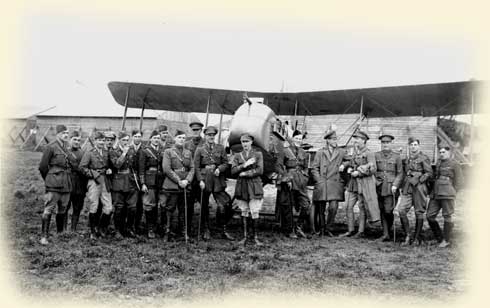 |
No 32 Squadron. Von Poellnitz is fourth from the right.
"The squadron's tasks would have been to patrol over the lines looking for the enemy, to establish air superiority and to escort reconnaissance aircraft and bombing machines. The first day of the Battle of the Somme, July 1, 1916, saw 32 Squadron in action. Not long after dawn Captain von Poellnitz took off in command of a formation of four aircraft which escorted a force of FE2bs on a bombing raid on Lille. He was mentioned again in the squadron diary on July 3. In company with 2nd Lieut.Hunt he was patrolling near Bethune at 13,000 feet when they saw a Roland reconnaissance aircraft 3000 feet above. They gave chase but it was too high and too keen to get home.
In the middle of the month the squadron was ordered to move south closer to the main battlefield and base itself at Vert Galand farm. The billets were less comfortable as the officers and men were in tents and the routine was flying offensive patrols (OPs) between Gommecourt and Bapaume, as well as escorting bombing missions.
On August 22, he had a lucky escape. He had taken the DH2 7914 up for a test flight. Soon after take-off the engine stopped, the aircraft stalled and he crashed into a cornfield. He was unhurt but the aircraft was very badly damaged. Confirmation of von Poellnitz's leadership ability and flying skills came in October when he was confirmed in the position of Flight Commander which he had been occupying over the summer and also in the rank of Captain in the RFC. On October 18, he was posted to No.24 Squadron at Bertangles as the commander of "B" Flight, also flying DH2s. Throughout November, "the Squadron intensified its patrols, each pilot flying up to four sorties per day, nine enemy aircraft were shot down." On December 17, it moved to Chipilly, "and as winter had now arrived, a quiet period enlivened by only a few incidents began." The respite was, however, of brief duration. There is no doubt that the squadron continued to fight fiercely against mounting odds At the start of the new year the CO received the following communication from the General Officer Commanding the RFC, "France, January 30, 1917 - To OC, 24 Squad., RFC. Congratulations to the pilots of the 24th Squadron on their work during the last five days. It is splendid. (Signed) Trenchard." However, for von Poellnitz, after almost a year's continuous combat, it was time for a rest. On April 14, 1917 he returned to England to take up instructing duties with No.10 (Reserve) Squadron at Joyce Green, near Dartford in Kent. The squadron was equipped with DH2s, Shorthorns, F.E.8s, Vickers FB5s and Vickers FB9s. Its prime function was to take pupils from basic training schools and give them the skills to help them survive in France. The instructor, a seasoned veteran, would take up a pupil in a dual control aircraft and demonstrate the manoeuvres that he would find useful in a dogfight. Then they would go up again in two machines and practise combat one against one
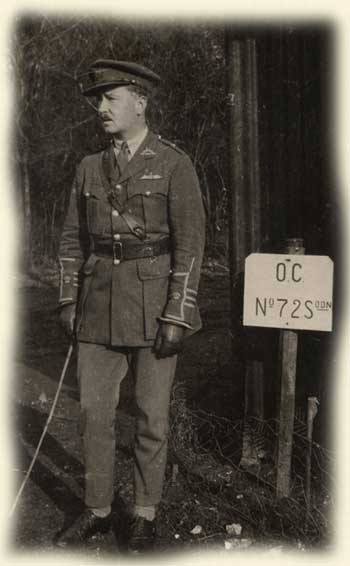
A contemporary on the staff at Joyce Green was the great British ace James McCudden. He described life there as follows, "Joyce Green was very handy to London and so a lot of us went up there nearly every evening, as it was only forty minutes' run. A few of the better known pilots who were also at Joyce Green at this time were Captains Long, Payn, von Poellnitz and Martin, all of whom, as well as myself, had flown de Havillands in France. This little band of fellows made life cheery I can assure you." The Baron and Baroness von Poellnitz were by this time living in Sidcup, a mere five miles or so from Joyce Green. Their son took the opportunity to make an aerial visit in May 1917 which was recorded in the Kentish Times as being the occasion of "the first Sidcup resident to fly over Sidcup." Von Poellnitz's career continued to progress as he was promoted Major to command a newly formed squadron, No.72, on June 28, 1917 at Upavon in Wiltshire. The squadron had three Avro 504s and a Sopwith Pup. Thirty-three officers were trained as scout pilots and sent on to other units. In November the squadron moved to Sedgeford in Norfolk and the junior officers were posted to France. Seven replacement officers arrived and the order came to prepare for service in Mesopotamia. The squadron was split into two groups, the first of which went by sea via the Cape of Good Hope, the second formed a convoy of vehicles to drive across France to Marseilles, "The transport party included 38 light tenders, four workshop lorries, one touring car, 22 trailers, eight motor cycles and other assorted vehicles, all of which arrived in Marseilles in spite of heavy snow and bad roads. At Marseilles they collected portable hangars, eight Bristol monoplanes, two DH4s and four SE5As. Eventually they took ship for Basra. Seventeen flying officers from Egypt joined the squadron at Basra".
British land and air forces had a two-fold purpose in the region - to protect oil interests in the Persian Gulf and to take the war to Germany's ally, the under-rated but nevertheless, formidable Turks.
The squadron arrived at Basra on March 2, 1918 and the three flights were dispatched to different locations. "A" Flight was sent to the 1st Corps at Samarra, north-west of Baghdad beside the River Tigris. It was equipped with DH4s, SE5As and the SPAD S.VIIs. "B" Flight remained in Baghdad with its two Martinsydes, operating under the control of General Headquarters (GHQ), while the eight Bristols of "C" Flight were based directly to the north of Baghdad at Mirjana, with the 3rd Corps. "C" Flight saw action on April 26, when Lieut.G.M.Lees MC and Lieut. W.M.Thomas attacked about 100 Turkish cavalry outside Kifri. This was followed up by further ground strafing over the next few days. In May, four of the Bristols of "C" Flight were temporarily stationed at Tuz Khurmatli and while they were there, they shot down at least one enemy aircraft.
Sadly, on May 10, the CO was severely injured in a car accident, he suffered a fractured skull whilst returning to his billet from Baghdad aerodrome. According to squadron member, Miles Thomas, Von Poellnitz drove into the River Tigris following a late night poker party. The following day he succumbed to his injuries and died at the age of twenty-seven. He is buried in Baghdad (North Gate) War Cemetery. It is a tribute to his leadership and organisational ability the squadron finished the campaign in Mesopotamia with six DFCs and one AFC having been won by squadron personnel.
His obituary appeared in the Kentish Times, "He was an airman of the highest promise and the most notable achievement. Not an airman who was addicted to pyrotechnical exploits but a steady, reliable and very expert flier; not given to looping the loop for no reason or risking his life in the unworthy cause of "showing off " but when serious or dangerous work was afoot, Major von Poellnitz was known to be the man who was capable of carrying it through. One of the bravest of our young men has passed away."
 |
My thanks to Guy Warner for allowing me to quote from his booklet, "Blandford to Baghdad - the Story of No 72 Squadron's First Commanding Officer". The book is available from the Ulster Aviation Society, contact being Ernie Cromie at : ernie.airni@gmail.com.
Society details at <http://www.ulsteraviationsociety.org>